Dr Amanda Franklin: Humans of BioSciences
Meet Dr Amanda Franklin, Research Fellow in biological optics in the School of BioSciences. Amanda researches the evolution of animal visual systems and animal colour patterns, specifically of Australian beetles such as the jewel beetle. Her research uses behaviour, physiology and microscopy to determine what beetles can see and the mechanism and function of different colours and patterns. Amanda also teaches and enjoys working with students and finding out inspires them about science. “I love my job because I can continue learning new things about fascinating topics.”

How did you develop your career in science?
I have worked at the University of Melbourne (UoM) since mid-2019. My pathway to my role has been a somewhat winding road, but importantly demonstrated that two things I was told during my PhD were not true: 1) if you leave academia you won’t be able to return and 2) government or industry don’t want to hire people with a PhD.
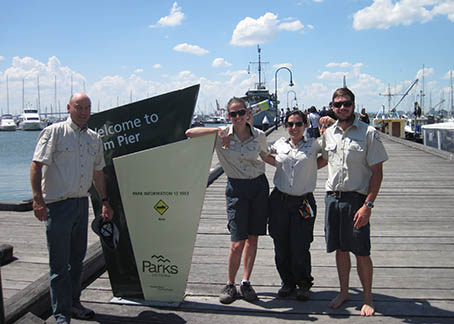
After completing my Bachelor of Science at UoM, I worked in a chemistry lab testing the nutritional value of food. I then returned to UoM to complete a Master of Science in Marine Biology at UoM researching the costs of mating in dumpling squid, which led me to a job as a marine park ranger with Parks Victoria, which involved lots of public engagement and science communication. Following this, I moved to Boston in the USA to complete my PhD at Tufts University where I researched communication and signalling in stomatopods. I didn’t have a job when I finished, so I travelled around the USA before moving back to Melbourne. Soon after getting back I began work as an Intelligence Analyst at Environment Protection Authority (EPA) Victoria before returning to UoM to take up my current job.
Image below shows Amanda (middle) with her colleagues at Parks Victoria
What problem are/were you trying to solve with your research?
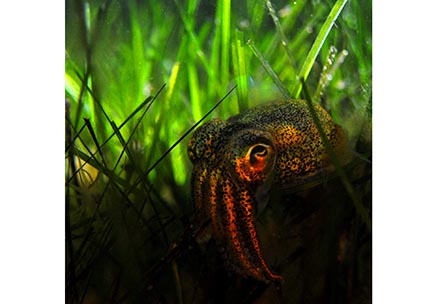
I am really interested in the evolution of animal visual systems and animal colouration. There is huge variation in what animals can see. For example, praying mantises can’t see colours, birds can see all the colours we can see as well as ultraviolet, and mantis shrimp (see image below) can see ultraviolet light, visible light as well as distinguish different types of polarised light!
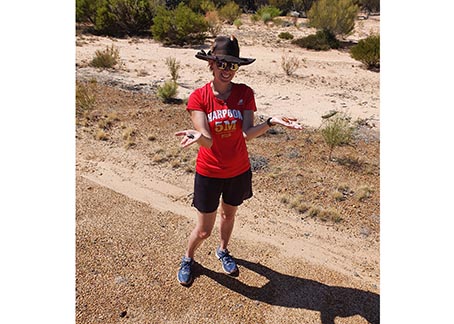
 The purpose of different colour patterns and visual effects is also diverse – including communication, camouflage and thermoregulation. I research vision and colour in Australian beetles. My research uses behaviour, physiology and microscopy to determine what beetles can see and the mechanism and function of different colours and patterns.
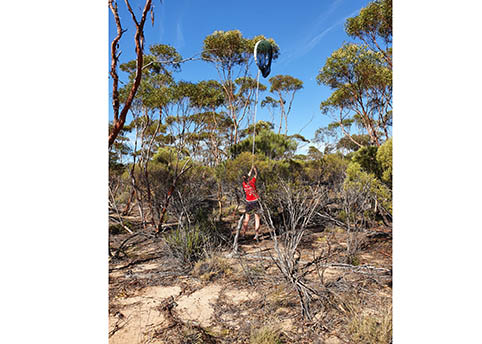
Image below shows Amanda releasing jewel beetles in Western Australia during fieldwork in January 2020, photo by Katrina Rankin
What do you enjoy doing outside of science?
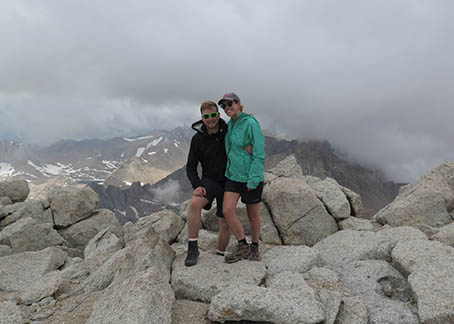
Outside of science I love being outside. I enjoy hiking and camping and spending time in nature. Nothing beats hiking to the top of a mountain and enjoying the view, or relaxing with a book on a remote beach. During lockdown, this hasn’t been an option, so I’ve picked up some at home activities. I sewed my first item of clothing (a top) and have begun very slowly knitting a cardigan. Maybe I will get it done by next winter!
Image below shows Amanda and her husband Doug at the top of Mount Langley in California. "Hardest hike I have ever done!"
Did you face any challenges during your PhD? If so, how did you overcome them?
I faced many challenges throughout my PhD. One that comes to mind occurred right at the beginning. My supervisor and I decided that mantis shrimp (marine crustaceans) would be a good group to investigate the types of questions I was interested in. However, neither of us had worked with mantis shrimp before. We didn’t know much about the practicalities of working with them, including the basics such as where to find them or how to house them. As you would expect, to overcome this, I did a lot of reading and googling. But there is so much information that is not available on google. So, I started cold-emailing mantis shrimp researchers around the world to ask them if they would chat to me on the phone. I was quite nervous to talk to these famous researchers, but they were friendly and gave me many tips about working with stomatopods as well as feedback on my research ideas. It led to fruitful collaborations and I learnt a lot. Furthermore, at conferences they introduced me to their students and collaborators, which has been great for scientific discussions and making new friends.
Do you have any advice for undergraduate students?
Always talk to people. As I mentioned above, this helped me to begin research on an organism I had never worked with. Meeting new people and maintaining the connections has helped me to learn new research techniques, identify opportunities and find jobs. Most of my research projects are collaborations with other labs so that I can learn techniques required to answer my research questions. In terms of professional development, friends and colleagues have told me about jobs that are being advertised, helped me with my CV/cover letter and provided me with teaching advice. I also enjoy giving back by helping others when I can.
Ask questions! Early in my PhD, I felt like I should already know everything and if I asked too many questions people would think I wasn’t clever enough to be doing a PhD. Many times, I would make a mental note when I didn’t understand something and then go research it further by myself. However, this regularly took a long time and sometimes I misinterpreted something about the topic and came to the wrong conclusion. This could lead to miscommunication between my advisor or colleagues and myself, just because I hadn’t asked the questions right at the beginning. Now I always try to ask questions and clarify when I’m not sure. Everyone is still learning and it is ok not to know everything.
Find out More
Dr Amanda Franklin profile: Find an Expert / Twitter / Google Scholar
Study at UoM: Bachelor of Science / Masters of Science (BioSciences)
Environment Protection Authority (EPA) Victoria
'Humans of BioSciences' is a special series to introduce the School of BioSciences' undergrad and postgrad students, our academics, professional staff and associates.