Professor Philip Batterham: Humans of BioSciences
Meet Professor Philip Batterham, Honorary Research Fellow and Professor of Genetics at the School of BioSciences and the Bio21 Institute at the University of Melbourne. Phil is a global leader in the genetics of insecticide resistance. He and his research group are currently investigating the impact of low doses of chemical insecticides on beneficial insects, as these may be contributing to significant population declines across the globe.
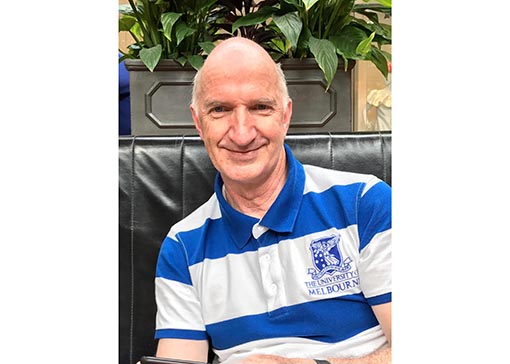
Over the past four decades, Phil has made a major contribution to our understanding of evolution and inspired countless undergraduate students and postgraduate researchers with a passion for his field. His excellence in research, teaching and science communication has garnered many awards such as the MJD White Medal from the Genetics Society of AustralAsia for his ‘lifetime contribution to genetics research’ and the Carrick Citation for his ‘exceptional record in the supervision, support and career mentoring of research higher degree students’. He has also been a five-time finalist in the Eureka Prize for Public Communication of Science.
Phil attributes his success to collaborative research and knowledge sharing. His research group tackles global problems by bringing diverse and talented minds together to find “deep shared satisfaction and success."
What inspires you about insecticides?
Interesting question. I think if I was ‘inspired’ by insecticides, I would be an extreme nerd. I Chuckle as I like to think that I’m not. When I began working on insecticides, it was because they provided the capacity to observe evolution happening in the field and to analyse it experimentally in the lab. This capacity to observe the evolution of insecticide resistance happening in real time is possible because it usually occurs in a period of a few years. Using the tools of molecular genetics we can identify the mutations responsible. Knowing that the insecticide is the selective agent, we can develop a sophisticated mechanistic understanding of molecular evolution that is near impossible to attain in other systems. We found that we could use mutagenesis and selection in the lab to generate the mutations that would arise in the field before they actually happened in the field.
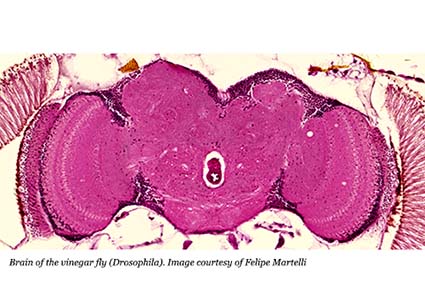
This research has many possible applications in pest control. It has also produced a deeper understanding of what insecticides do to insects. This had fuelled my current interest – investigating the impact that low doses of insecticides have on non-pest insects as this may contribute to the significant declines in insect populations being observed around the world. My work is largely on the vinegar fly (Drosophila), a non-pest insect, that is used as a genetic model. It is found in every part of the world where humans live. NASA has even sent these flies into space for experimental purposes. The below image, courtesy of my previous student Felipe Martelli, shows the brain of the vinegar fly which is the site of action of the insecticides we work on.
What makes collaborative and complementary research and learning so important (and enjoyable)?
Way back in the mid-1970s I was one of the co-founders of what became a large amateur theatre company. For a few years I performed in plays and musicals, but more talented performers came along and I became increasingly attracted to off-stage roles that helped these people to shine. The most satisfying role for me was being the producer, the person responsible for coordinating the contributions of the key personnel (director, choreographer, musical director and set, lighting and costume designers etc etc) and forming a unified vision of what the show would be like. I produced plays, musicals, major Christmas concerts in a park and a street festival in Preston attended by 20,000 people. Being a producer brought so many challenges, but it shaped the way I operate as a researcher. There were occasions where, the team of people of diverse talents that I assembled created sheer magic on stage. Their talents did not add together, they multiplied. I was a catalyst and these remarkable people did the rest. There was a palpable camaraderie shaped by the shared commitment of energy and talent. Sacrifices made ‘for the show’ seemed small compared to the sheer joy and intense satisfaction when the magic happened. In running my lab, I have always strived to be the producer, uniting people with different skills and interests, striving to create an environment where the team finds deep shared satisfaction and success. As our science requires inputs from fields that sit outside our expertise, I have needed to establish collaborations. Joining forces with stars who are not a part of our team has contributed enormously to the quality of our production.

What gives you hope for the future?
This is the easiest question for me to answer. My hope rests in my students and colleagues. I have the privilege of working with people who are incredibly talented, passionate and committed. We are currently travelling through dark times, and we feel down, but we are not out, not by a longshot. The remarkable people of the School of BioSciences and Bio21, where my lab lives, will endure and carry us forward into bright future.
What is your favourite (or even most outlandish) memory of working in the School of BioSciences?
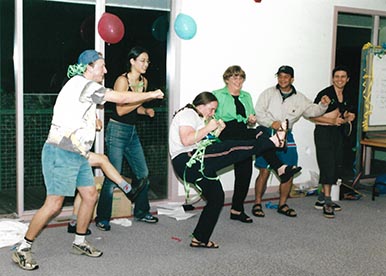
My memories go way too far back to times when health and safety in the work place was not a shared concern. There were many pranks pulled and games played that quite rightly would not be permissible now. So I had better not tell you those stories. I do fondly remember departmental camps down at a University farm (Strathfieldsaye) near Sale. Everyone was invited and a wonderful cross section of people would attend - academics, office staff, honours and PhD students, our photographer, prep room staff and Cos, the man who kept our Department running with his capacity to make, maintain and repair. Arriving on a Friday night and leaving on a Sunday afternoon we had incredible fun, with the highlight being the Saturday night concert with everyone participating, taking the real risk of looking silly. We slept in tents and shearers’ quarters. We talked very little about science, but got to know each other a whole lot better and returned to work a more united team having had the experience.
Find out more
Professor Philip Batterham: Find an Expert
Bio21 Molecular Science and Biotechnology Institute
Genetics Society of AustralAsia
'Humans of BioSciences' is a special series to introduce the School of BioSciences' undergrad and postgrad students, our academics, professional staff and associates.