BEAM Group
Behavioural Ecology and Macroevolution
Welcome to the Behavioural Ecology and Macroevolution group at the University of Melbourne.
Our group is interested in the study of behavioural ecology from a broad evolutionary perspective. We use comparative analyses and field and lab experiments to answer different questions about nature.

Interested in working with us?
Prospective students
We are happy to hear from potential Master's or PhD students interested in studying behavioural ecology from a broad evolutionary perspective. You can decide if you want to work with fieldwork, phylogenetic/comparative analyses, meta-analyses or a combination of everything. I am keen to work with enthusiastic and curious students that want to increase our understanding of the natural world.
If this sounds like you contact me at iliana.medina@unimelb.edu.au. There are funding opportunities for competitive students at University of Melbourne.
Postdocs
The University of Melbourne offers McKenzie Research Fellowships and there are other sources like the human frontiers program or ARC funded postdocs, I am keen to host and establish collaborations with early career researchers all over the world.
-
Applications are open for PhD programs 2026
If you are interested in the macroevolution of anti predator strategies in insects, analysing large datasets on invasive species, send me an e-mail with your transcripts (non-official is fine), CV and research interests.
Applications are open for MSc students 2026
If you are interested in nest evolution, comparative analyses to study animal architecture, or laboratory experiments on animals with warning signals, please send me an e-mail with your transcripts and research interests.
Contact
For enquiries, please email Dr Iliana Medina – iliana.medina@unimelb.edu.au
Meet the academics and researchers in the BEAM research group.
Our people
Dr Iliana Medina Guzman
I am a behavioural ecologist and evolutionary biologist and I am fascinated by the evolution of animal behaviour. I am originally from Colombia and did my PhD at ANU (2012-2016) and now have a group based at University of Melbourne. We explore the drivers of variation in behaviours and the consequences that behavioural interactions have at a broad scale. My work focuses mainly on two topics: the evolution of warning colourations and the evolution of bird traits, such as colour and nest design.
iliana.medina@unimelb.edu.au
Chenyue Yang
Chenyue is a PhD student (2025–2029) from China, co-supervised by Prof. Shai Meiri. She is broadly interested in avian behavioural ecology and macroevolution. Chenyue’s research focuses on the macroevolution of flexibility in birds’ nest-building behaviours, combining museum collections, field measurements, and comparative analyses.
Dr Jessica McLachlan
Jessica is our incredible research assistant and who coordinates and leads all our field seasons. She is an amazing birder and brilliant biologist who loves nature, and who happens to be a wonderful photographer too!
jessica.mclachlan@unimelb.edu.au
Kei-Lin Ooi
Kei-Lin is a PhD student (2021-2025) co-supervised by Prof. Devi Stuart-Fox. Kei-Lin explores the drivers and consequences of having warning signals in butterflies and insects from a macroevolutionary approach.
keilin.ooi@unimelb.edu.au
Tara Jindal
Tarani is an international MSc student from India (2024-2026), co-supervised by Dr. Damien Esquerre. She is Interested in behavioural and evolutionary biology. Her research will focus on studying sex-biased dispersal in Harlequin bugs. Having worked with birds, fish and snakes in India, she is keen to explore the incredible fauna in Australia, both marine and terrestrial. Outside of research, Tarani enjoys performing arts (such as theatre and dance).
tara.jindal@unimelb.edu.au
Amy Carboon
Amy is a MSc student (2023-2025) co-supervised by Prof. Devi Stuart-Fox. Amy’s work explores the links between courtship behaviours and visual effects in bird feathers. She collates detailed measures of iridescence on museum feathers from many different species and will relate these measures to mating behaviours.
a.carboon@unimelb.edu.au
Alexis Goh
Alexis is a PhD student (2024-2028) from Singapore, co-supervised by Prof. Devi Stuart-Fox and Prof. Megan Head. She has a keen interest in conservation, entomology, and behavioural ecology. Alexis will be investigating how native leaf beetles can deter predators, using their colourful appearances, behaviours, and toxic defenses.
alexis.goh.1@unimelb.edu.auPrevious students and team members
- Claire Taylor (post-doc): All things nests and fairy-wrens. Visit Claire’s website.
- Fabian Salgado-Roa (PhD student): Evolution of colour polymorphic spiders. Visit Fabian’s website.
- Justin Cally (MSc student): Links between sexual selection and speciation in birds.
- Wen-Yun Liao (MPhil student): Near-infrared reflectance as an adaptation in bird eggs.
- Oliver Wardle (MSc student): Nesting preferences in red-tail black cockatoos.
- Emmet Mulcahy (Honours): Variation within species in near-infrared reflectance.
- Sophie Roberts (Honours): The evolution of warning signals in frogs.
Our main research interests in behavioural ecology and macroevolution
The evolution of warning signals
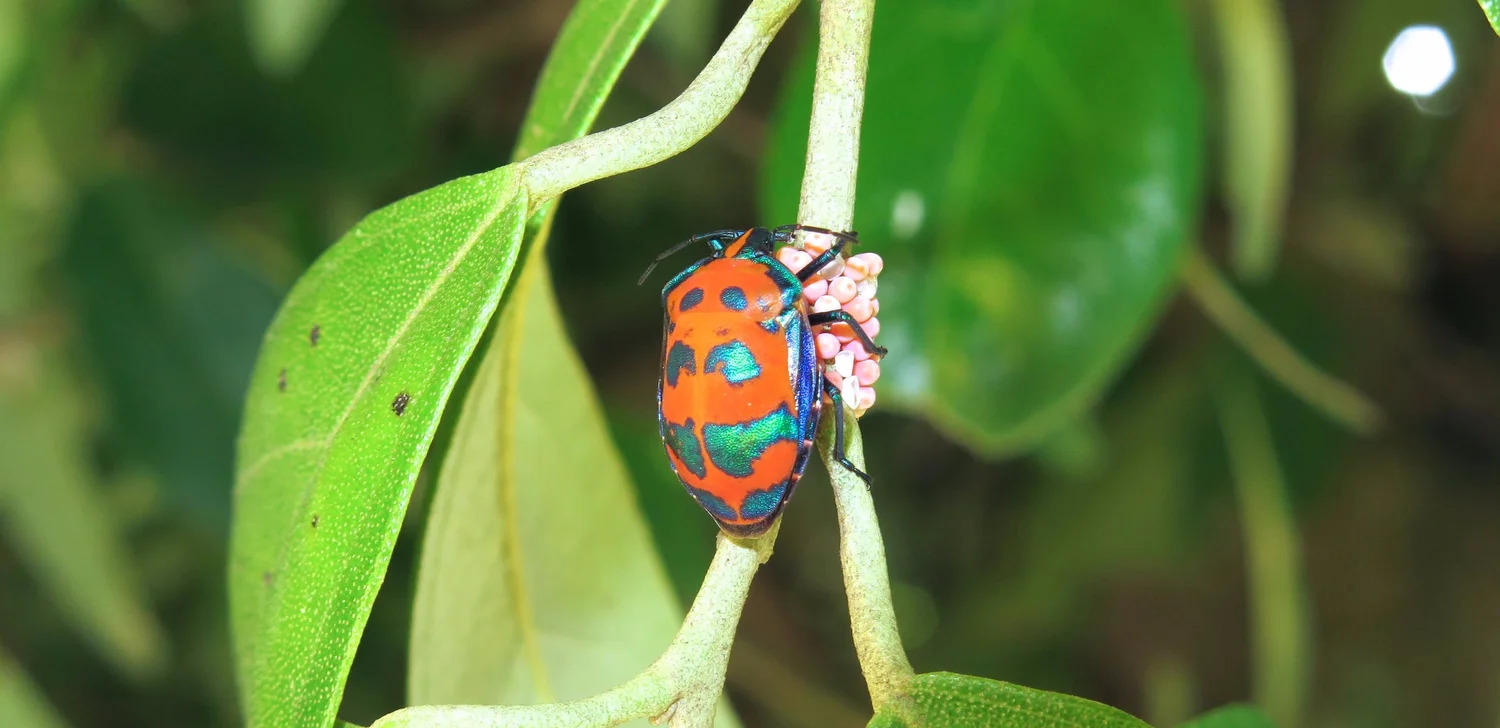
How do species with warning signals disperse, diverge and diversify? Our aim is to use the Cotton Harlequin Bug as a model system to understand how these processes occur.
Related projects include the evolution of ontogenetic colour change in species with warning signals, specifically jewel bugs and butterflies.
Related publications
Medina, I., Dong, C., Marquez, R., Perez, D. M., Wang, I. J., & Stuart-Fox, D. (2024). Anti-predator defences are linked with high levels of genetic differentiation in frogs. Proceedings of the Royal Society B, 291(2015), 20232292.
Roberts, S. M., Stuart‐Fox, D., & Medina, I. (2022). The evolution of conspicuousness in frogs: When to signal toxicity?. Journal of Evolutionary Biology, 35(11), 1455-1464.
Collaborators
Egg and nest evolution
Nests and eggs are key parts of the extended phenotype of birds and our group investigates how these ‘structures’ have evolved, using as study system Australian passerines but also analysing data at macro-evolutionary scale. Surprisingly, there is little known about the broad scale evolutionary drivers of nest architecture.
We do experiments in the field and use information from museums to understand how nests and eggs adapt to their environment and why they are so variable.
Related publications
Colombo, S., Newman, K. D., Langmore, N. E., Taylor, C. J., & Medina, I. (2024). The role of climatic variables on nest evolution in tanagers. Ecology and Evolution, 14(4), e11168.
Medina, I., Perez, D., Silva, A., Cally, J., Leon, C., Maliet, O., & Quintero, I. (2021). Nest architecture is linked with ecological success in songbirds. Ecology Letters.
Collaborators
Brood parasites
Brood parasites like cuckoos and cowbirds lay their eggs in the nests of other species and we are interested in understanding how this behaviour affects hosts and parasites at a macroevolutionary scale.
Related publications
Langmore, N. E., Grealy, A., Noh, H. J., Medina, I., Skeels, A., Grant, J., ... & Holleley, C. E. (2024). Coevolution with hosts underpins speciation in brood-parasitic cuckoos. Science, 384(6699), 1030-1036.
Medina, I., Kilner, R. & Langmore, N.E. (2020) From micro- to macro-evolution: brood parasitism as a driver of phenotypic diversity in birds. Current Zoology 66(5): 515-526
Collaborators
Selected publications
To view a complete and updated list of publications
Don't have access to a paper? Please email - iliana.medina@unimelb.edu.au
Experimental increase in eviction load does not impose a growth cost for cuckoo chicks. I Medina, ML Hall, CJ Taylor, RA Mulder, NE Langmore - Behavioral Ecology and Sociobiology, 2019
Climate is a strong predictor of near-infrared reflectance but a poor predictor of colour in butterflies. JT Munro, I Medina, K Walker, A Moussalli, K Rankin, D Stuart-Fox - Proceedings of the Royal Society B, 2019
Conspicuous Plumage Does Not Increase Predation Risk: A Continent-Wide Test Using Model Songbirds. KE Cain, ML Hall, I Medina, AV Leitao, K Delhey, L Brouwer, A Peters, S Pruet-Jones, M Webster, N Langmore, R Mulder - The American Naturalist, 2019
Nest illumination and the evolution of egg rejection in hosts of brood parasites. I Medina, NE Langmore - The Auk: Ornithological Advances, 2019
Host density predicts the probability of parasitism by avian brood parasites. I Medina, NE Langmore - Philosophical Transactions of the Royal Society B, 2019
The role of the environment in the evolution of nest shape in Australian passerines. I Medina - Scientific reports, 2019 PDF
Reflection of near-infrared light confers thermal protection in birds. I Medina, E Newton, MR Kearney, RA Mulder, W. Porter, D. Stuart-Fox - Nature communications, 2018 PDF
Walk, swim or fly? Locomotor mode predicts genetic differentiation in vertebrates. I Medina, GM Cooke, TJ Ord - Ecology letters, 2018
Tolerance in hosts of brood parasites: a comment on Avilés. I Medina, NE Langmore - Behavioral Ecology, 2017 PDF
Habitat structure is linked to the evolution of plumage colour in female, but not male, fairy-wrens. I Medina, K Delhey, A Peters, KE Cain, ML Hall, R Mulder, N Langmore - BMC evolutionary biology, 2017 PDF
Egg shape mimicry in parasitic cuckoos. MRG Attard, I Medina, NE Langmore, E Sherratt - Journal of evolutionary biology, 2017 PDF
The evolution of clutch size in hosts of avian brood parasites. I Medina, NE Langmore, R Lanfear, H Kokko - The American Naturalist, 2017 PDF
Conspicuousness, color resemblance, and toxicity in geographically diverging mimicry: The pan‐Amazonian frog Allobates femoralis. A Amézquita, Ó Ramos, MC González, C Rodríguez, I. Medina, P. Simoes, A. Lima - Evolution, 2017
Evolution of dorsal pattern variation in Greater Antillean Anolis lizards. I Medina, JB Losos, DL Mahler - Biological Journal of the Linnean Society, 2016
Brood parasitism is linked to egg pattern diversity within and among species of Australian passerines. I Medina, J Troscianko, M Stevens, NE Langmore - The American Naturalist, 2016
Ecological and socio-economic factors affecting extinction risk in parrots. G Olah, SHM Butchart, A Symes, I Medina… - Biodiversity and Conservation, 2016
Batten down the thatches: front-line defences in an apparently defenceless cuckoo host. I Medina, NE Langmore - Animal behaviour, 2016
Coevolution is linked with phenotypic diversification but not speciation in avian brood parasites. I Medina, NE Langmore - Proceedings of the Royal Society B, 2015
The costs of avian brood parasitism explain variation in egg rejection behaviour in hosts. I Medina, NE Langmore - Biology letters, 2015
Tantilla alticola (Boulenger, 1903)(Squamata: Colubridae): filling a geographical distribution gap in western Colombia. J Vanega-Guerrero, A Batista, I Medina, F Vargas-Salinas - 2015
Brood parasitism and the evolution of cooperative breeding in birds. WE Feeney, I Medina, M Somveille, R Heinsohn, M Hall, R. Mulder, JA Stain, R.M. Kilner, N Langmore - Science, 2013
Hybridization promotes color polymorphism in the aposematic harlequin poison frog, Oophaga histrionica. I Medina, IJ Wang, C Salazar, A Amézquita - Ecology and evolution, 2013
Environmental variability and acoustic signals: a multi-level approach in songbirds. I Medina, CD Francis - Biology Letters, 2012
Dispersal syndromes among three landscape units in Colombian lowland Amazonia. MN Umaña, P Stevenson, AB Hurtado, D Correa, I Medina - The International Journal of Plant Reproductive Biology, 2011