Glitter can be released into the environment, like other microplastics, and so it tends to accumulate and ends up increasing plastic pollution. In general, glitter is composed of three layers: a core polymer film, coated with a coloured aluminium layer and then topped with a thin polymer layer.
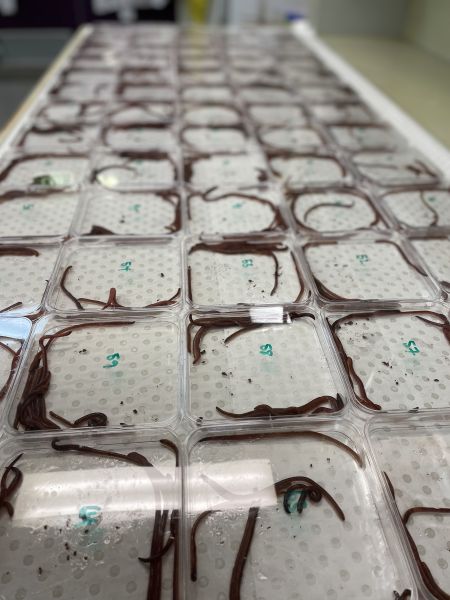
SoilTox Lab collaborators at the University of Cambridge have developed novel cellulose nanocrystals that have the potential to be used as a biodegradable and more environmentally friendly glitter replacement. However, there is no available information on the impacts of conventional glitter or cellulose nanocrystal glitter on soil ecosystems. Thus, this project is investigating the impacts of conventional cellulose glitters on earthworms and springtails, while our collaborators at Anglia Ruskin University are investigating the impacts on aquatic organisms. The University of Melbourne research is being undertaken by two Masters students.
Timeframe: 2022-2024
Project team: Assoc. Prof. Suzie Reichman (University of Melbourne), Prof. Silvia Vignolini (University of Cambridge), Dr Benjamin Drouget (University of Cambridge and Sparxell), Assoc. Prof. Dannielle Green (Anglia Ruskin University), Mr Po-Hao Chen (Master Environment student, University of Melbourne), Mr Ian Lam (Master Science (BioSciences) student, University of Melbourne
Funding / sponsors: University of Cambridge, Anglia Ruskin University, Sparxell
Contact: Associate Professor, Suzie Reichman
Links & Resources
Scientists create new type of eco-glitter made from biodegradable, sustainable materials. ABC Online, 12 November 2021
Droguet, B.E., Liang, HL., Frka-Petesic, B., Parker, R.M., De Volder, M.F.L., Baumberg, J.J., and Vignolini, S.. 2022. Large-scale fabrication of structurally coloured cellulose nanocrystal films and effect pigments. Nature Materials. 21, 352–358.